
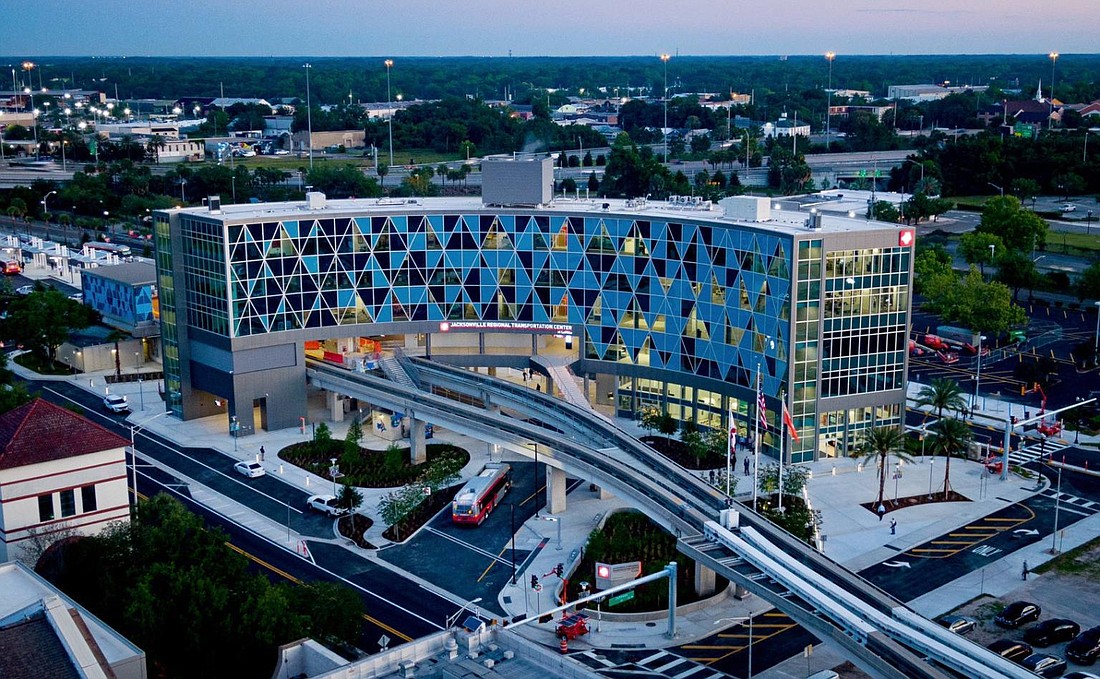
The Jacksonville Transportation Authority is set to eliminate some routes and increase some fares in order to make up for a projected $17.5 million budget deficit in fiscal year 2027.
JTA plans to trim services for some of its bus and ReadiRide routes, and shorten hours for its Downtown Neighborhood Autonomous Vehicle Innovation service. It would also transition ReadiRide service into Uber fares, while increasing bus fares that it had lowered in a pilot program months before.
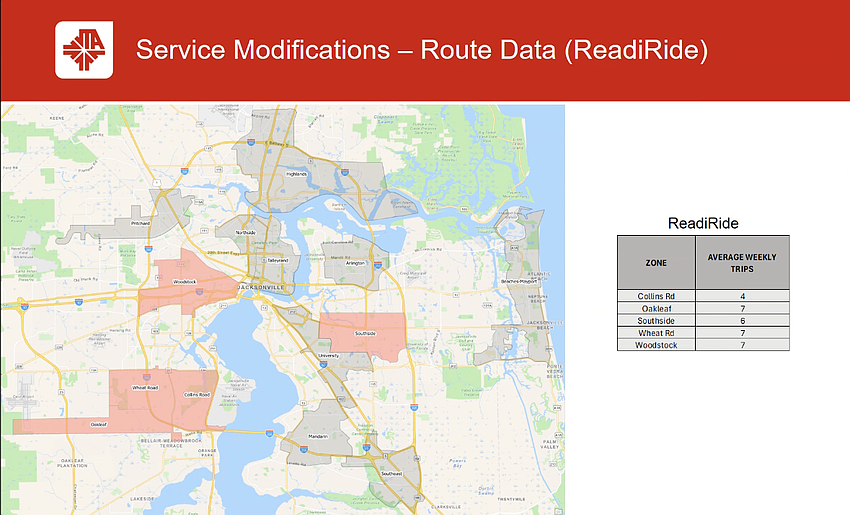
ReadiRide is a shuttle service that users can book by phone, which services door-to-door rides in 14 areas around Duval County. NAVI is the first portion of JTA’s Ultimate Urban Circulator (U2C) program. The first phase, which cost $65 million, runs autonomous vehicles along a 3.5-mile route mostly along Bay Street.
With a 7-0 vote May 28, JTA’s board of directors approved a $139.2 million FY27 budget, which included the plans to balance the expected deficit. Like the city and other independent authorities, JTA’s fiscal year runs Oct. 1 to Sept. 31.
Pending a final review in August, the increased fares would take effect in January 2027, allowing JTA customers to have some time before the end of a six-month fare reduction pilot program Aug. 1. JTA’s service cuts would begin Oct. 1.
The board’s approved reductions to expenses are as follows:
• $8.37 million by altering the frequency of four bus routes, including all four First Coast Flyer bus routes. The First Coast Flyer and three other bus routes would see frequency reduced from 20 to 25 minutes, while seven more bus routes would see service reduced from 30 to 60 minutes.
• $2.79 million by eliminating five bus routes.
• $1.72 million by reducing the frequency of NAVI service from seven minutes to 12 minutes.
• $130,608 by eliminating five ReadiRide zones.
• Save $200,000 by offering Uber vouchers in place of ReadiRide service.
JTA expects service cuts to save $13.62 million.
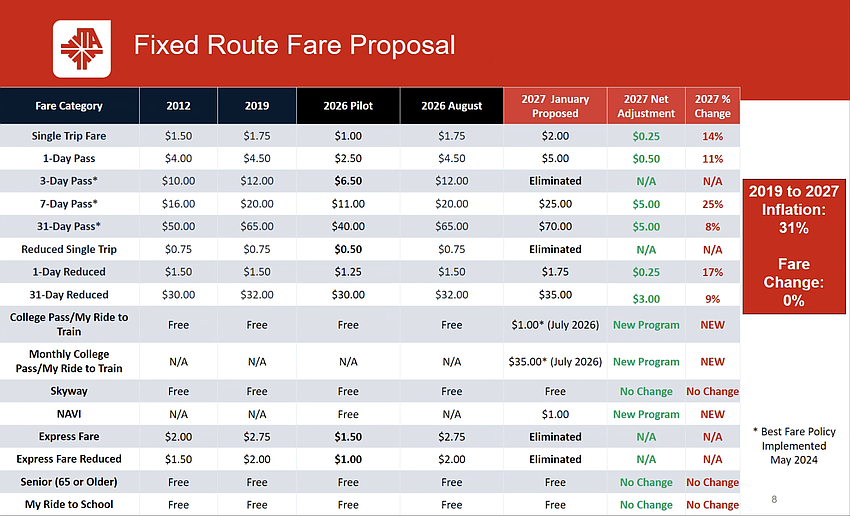
JTA would also raise some bus fares. Among them, single trip would be $2, up 25 cents, and a 31-day pass would increase to $70 from $65. Three-day passes and reduced single trips would be eliminated.
Riders ages 65 and older would continue to ride for free, and the My Ride to School program and Skyway service also would continue at no charge.
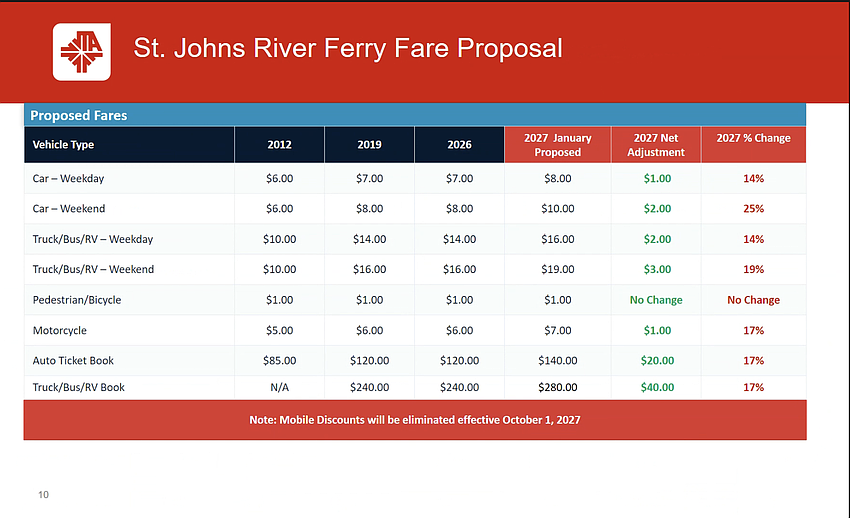
Additionally, JTA would charge $35 for a previously free monthly pass for students and those traveling to job training, and increase fares for those using the St. Johns River Ferry. For the ferry, the fee for a car on weekdays would increase to $8 from $7, and on weekends to $10 from $8.
NAVI fares, which have been free since December 2025, would be $1. NAVI fares previously were $1.75 from October to December 2025, after an initial free-fare pilot program.
JTA expects its combined fare increases to generate $1.57 million in additional revenue.
Between the service cuts and fare increases, JTA still expects a $2.31 million deficit. The authority told board members it would seek to cut $2.3 million in expenses with administrative reductions.
Board members approved the measures based on a conservative estimate of how much sales tax the authority would receive. While JTA staff expected that the authority would receive $86 million in a half-cent sales tax charged by the city of Jacksonville and given to JTA, board members based their FY27 budget on an estimate of receiving $80 million.
“We cannot do this again like we did this year,” board member Daniel Vallencourt said, referencing JTA’s $10.85 million deficit in sales tax. “The economy is slowing down. You may come in with $75 million sales tax revenue.”
While noting their disappointment in the need for changes, the board noted that JTA’s fares would still be lower than similar Southeast markets.
“It’s not something that we wanted to do, but it is something that we’ve got to do,” board Chair Aundra Wallace said.
“This is probably during my tenure as your CEO, one of the most consequential and difficult decisions I’ve seen the JTA board face,” CEO Nat Ford said.
“JTA is not navigating a unique or self-imposed crisis across the country. Transit agencies are grappling with the same structural pressures that are challenges that are coming because of the economic environments they’re operating in.”
Following the board vote, JTA will submit its budget to the city. The authority will then analyze its service reductions under Title VI requirements from the Federal Transit Administration. Those requirements state that programs that receive federal funding cannot discriminate against anyone on the grounds of race, color or national origin.
Following that review, the board would need to vote at its August board meeting on any required amendment to its budget should JTA need to make any changes.
The fiscal year 2027 deficit comes one year after a projected $13.28 million deficit for FY26. The authority has instituted layoffs and furloughs to make up for lost revenue.
In addition to the projected $10.53 million in lost sales tax revenue , JTA expects to lose $2.03 million in interest earnings and $723,387 in passenger fares in FY26.